
Pakistan's Prime Minister Shehbaz Sharif has offered to mediate between the US and Iran to de-escalate the ongoing conflict in West Asia, following a joint US-Israel attack on Iran. Sharif has been in contact with Saudi Arabia, the UAE, and other nations to promote dialogue and diplomacy.

US Vice President JD Vance has postponed his visit to Switzerland for technical talks with Iranian negotiators, citing logistical issues. These negotiations are crucial for finalising the details of a recently signed peace deal between the US and Iran, which aims to end the conflict in West Asia and includes a 60-day period for technical discussions.

The US has threatened to prosecute those buying or selling sanctioned Iranian oil and has announced a blockade of the Strait of Hormuz after peace talks failed.

US President Donald Trump has rejected Iran's proposal to end the ongoing war, deeming it 'totally unacceptable'. This decision comes amid efforts to negotiate an end to hostilities that began on February 28 and have disrupted global oil supplies.

'The real money in India over the coming period is likely to be made in small-cap stocks rather than in the large-cap benchmark names.'

US President Donald Trump threatened to bomb Iran if a deal is not reached before the ceasefire ends, while Pakistan urged both sides to extend the truce and pursue diplomacy.

Prem Panicker's Must Read Blog On The Gulf War.

Iran has presented a multi-layered proposal to the US in an attempt to break the deadlock in peace talks, focusing on de-escalation and nuclear programme discussions.

Iran's World Cup football team has finally received visas to enter the United States, just days before their first match in Los Angeles.

The harsh truth is that the US is no longer a reliable partner, cautions Ramesh Menon.

Israeli Prime Minister Benjamin Netanyahu on Thursday called for the opening of direct negotiations with Lebanon, as tensions persist along the border despite a two-week ceasefire aimed at halting hostilities in West Asia.

US President Donald Trump has indefinitely extended the ceasefire with Iran at the request of Pakistan, aiming to allow Tehran's leadership time to form a unified proposal to end the seven-week war.

US Vice President J D Vance stated that while progress was made during peace talks in Islamabad, it is now up to Iran to further the discussions and address US concerns regarding its nuclear ambitions.

The US military carried out 'self-defence strikes' targeting Iranian missile launch sites and boats near the Strait of Hormuz, even as President Trump announced progress in ceasefire negotiations, stating Iran's enriched uranium will be 'turned over' or destroyed.

US President Donald Trump claimed on Tuesday that Tehran has consented to long-term, comprehensive monitoring of its nuclear infrastructure. Concurrently, Washington will ease shipping constraints in the Strait of Hormuz and release bound financial concessions, subject to stringent American oversight.

Indian benchmark equity indices, Sensex and Nifty, ended lower after a five-day rally, with the Sensex dropping 607 points and the Nifty falling to 24,013.10. The decline was primarily driven by heavy selling in IT firms following Accenture's trimmed revenue guidance and renewed geopolitical uncertainty, specifically the postponement of US-Iran negotiations.

Trump seems to have estimated that Ghalibaf is a pragmatic politician who is receptive to close relations with the US and is enthusiastic about fostering business and economic ties in particular, points out Ambassador M K Bhadrakumar.

Pakistani Prime Minister Shehbaz Sharif has briefed Saudi Crown Prince Mohammad bin Salman on Pakistan's diplomatic efforts to de-escalate the situation in West Asia. This follows Pakistan's offer to host talks between the US and Iran to resolve the ongoing conflict.

The Gulf countries on Monday welcomed a peace deal reached between the US and Iran to end their conflict and called for protection of maritime routes and freedom of international navigation, including the uninterrupted flow of traffic through the Strait of Hormuz.

Prime Minister Narendra Modi has called for a swift end to the conflicts in West Asia and Ukraine, emphasising the importance of dialogue and diplomacy. He made the remarks after talks with Finnish President Alexander Stubb, where they also agreed to a strategic partnership in digitalisation and sustainability.

The ceasefire is still technically holding, to the extent that no overt hostilities have been reported yet, but the rhetoric has hardened dangerously. The week ahead will also clarify whether the Islamabad failure was a negotiating tactic or whether Washington has genuinely locked itself into a position from which the only exits are climb-down, escalation, or the slow bleed of a new status quo that nobody chose and nobody controls. Prem Panicker continues his must read blog on the Iran War.

A US military Apache attack helicopter crashed near the Strait of Hormuz, with its crew successfully rescued, as US President Donald Trump confidently declared an imminent 'total victory' over Iran within two weeks and a new nuclear deal, despite ongoing regional volatility and a recent de-escalation between Iran and Israel.

Chaffing under public ridicule in the US as well as internationally for having 'lost' the war, Trump is under immense pressure to do something, cautions Ambassador M K Bhadrakumar.

The strike came amid the peace deal talks between two countries and a fragile ceasefire.
Pakistan's Prime Minister Shehbaz Sharif has welcomed the ceasefire between the US and Iran and invited delegations from both countries to Islamabad for peace negotiations.

A new assessment by the Institute for the Study of War (ISW) reveals that a power struggle within Iran's leadership, with hardliners gaining influence, could significantly impact future negotiations with the United States.
China has called on Iran to reopen the Strait of Hormuz and expressed appreciation for Tehran's commitment not to develop nuclear weapons, a key demand of the US to end the conflict.

Iran's state broadcaster denies sending a diplomatic delegation to Pakistan for talks with the US, despite reports suggesting otherwise. This denial comes amid escalating tensions and aggressive rhetoric from Washington, even as signs of potential diplomatic movement emerge.

India and Israel have elevated their relationship to a special strategic partnership, focusing on enhanced cooperation in trade, technology, and defense, while also addressing regional peace initiatives.

The popularity of US President Donald Trump is waning with approval ratings at its lowest, according to former diplomat Mahesh Sachdev, who notes that with two-thirds of Americans not approving of a continuation of the war on Iran, Trump faces the risk of being impeached.

The United States Central Command (CENTCOM) has confirmed the implementation of a naval blockade on Iranian ports, enforcing strict measures on vessels entering or departing, significantly escalating tensions between the two nations.

China has criticised the US blockade of the Strait of Hormuz, calling it a dangerous and irresponsible move, and urged Washington and Tehran to honour the ceasefire. Beijing also denied aiding Iran militarily and threatened countermeasures if the US imposes tariffs.

The core issues to be settled -- access to Hormuz, Israel's aggression in Lebanon, the question of Iran's nuclear programme, sanctions relief and compensation -- are thorny enough to require weeks of patient negotiation. The most likely outcome of the opening sessions is that both sides take the measure of each other, establish what is and is not negotiable, and return home without having broken anything. That would count as progress.

Trump has made it clear: the US will not lift its blockade of Iranian ports until a deal is signed.

...is a way out, notes Prem Panicker in his must read blog on the Iran War. What the indefinite extension produces is a prolonged condition of not-war-not-peace, in which oil markets cannot stabilise, Asian refineries cannot plan, European governments cannot stop subsidising consumption they cannot afford, and the next flashpoint -- a seized tanker, a miscalculated drone strike, a Truth Social post that claims too much -- is one news cycle away.

Trump added that the United States would assist in managing the traffic buildup in the Strait of Hormuz.
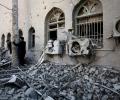
The logic of war plus the gathering storms in US politics as the midterms loom large leave him with no real alternative but to negotiate, points out Ambassador M K Bhadrakumar.

The US Navy seized an Iranian-flagged cargo ship in the Gulf of Oman, escalating tensions as ceasefire talks face uncertainty. The incident raises concerns about the fragile ceasefire and the ongoing blockade of the Strait of Hormuz.

'In a volatile global market, India is pursuing a low-risk, low-return policy, akin to a SIP -- slow, steady investment.' 'Pakistan is following a high-risk, high-return policy.'

Iranian military spokesperson said that stability in the region would be ensured only by the strength of Iran's armed forces and warned that energy and oil markets would not return to previous levels unless this reality was acknowledged.
